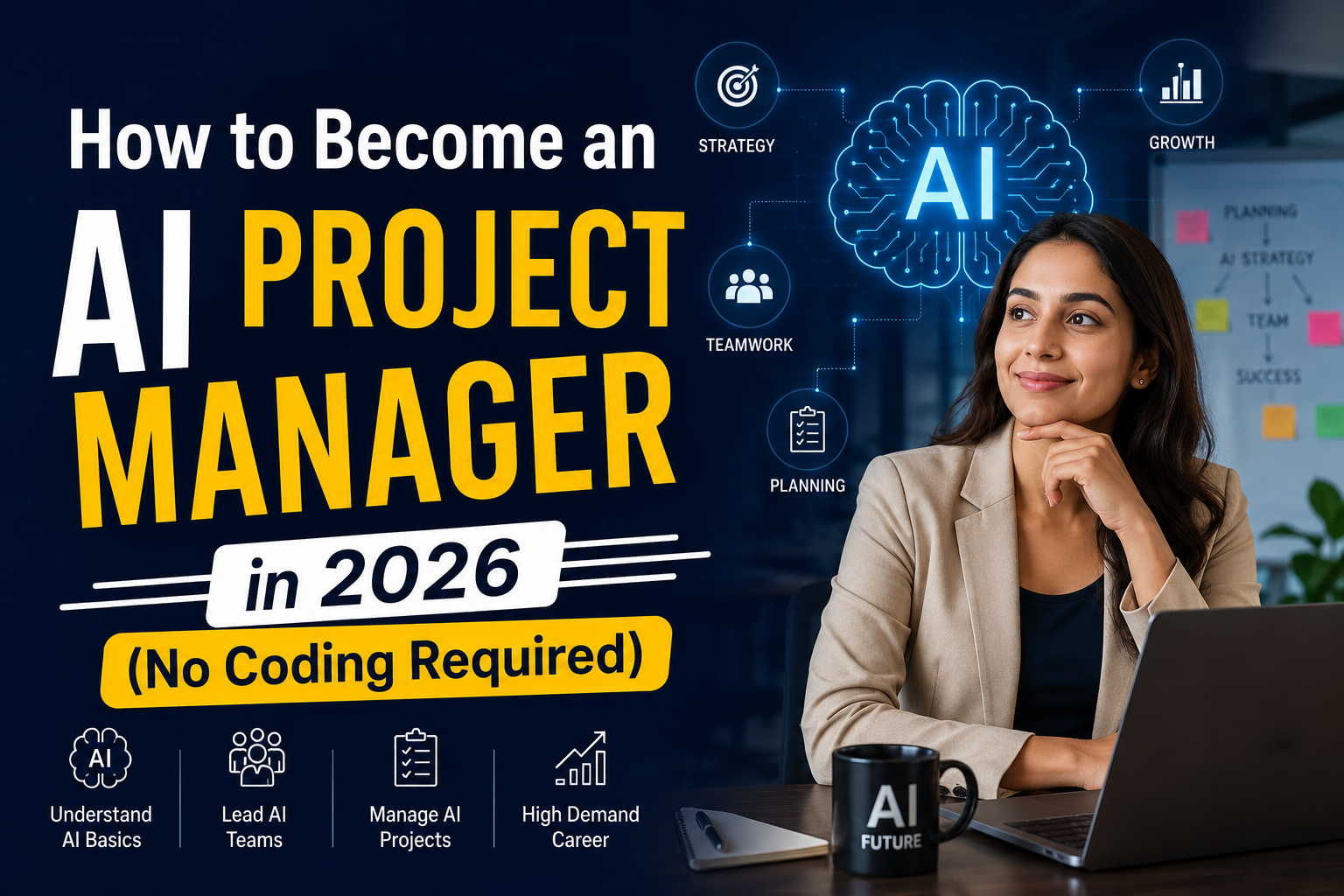
Most project managers in Bengaluru, Hyderabad, and Pune know that adding 'AI' to their resume is no longer optional. Yet, dozens of delivery managers and Scrum practitioners hold back from getting certified in Cognitive Project Management for AI (CPMAI) because of outdated assumptions circulating across LinkedIn and office watercoolers. Let us dismantle those misconceptions with cold, hard facts.
4 Persistent Myths About CPMAI Certification Debunked
Before you let hesitation stall your career progression in India's booming IT service and GCC (Global Capability Center) ecosystem, let us look at what CPMAI actually entails.
Myth 1: "You need to write Python code and build neural networks to pass"
Fact: CPMAI is a project governance and delivery framework, not a data science bootcamp. You do not need to fine-tune large language models or write PyTorch pipelines. The certification teaches you how to scope AI initiatives, assess data readiness, handle algorithmic bias, manage drift, and align machine learning milestones with enterprise business objectives. It bridges the gap between data scientists who write models and CXOs who demand business ROI.
Myth 2: "Standard Agile and PMP frameworks are enough for AI projects"
Fact: More than 80% of enterprise AI projects fail, and the primary culprit is treating probabilistic AI like deterministic software. Standard Agile assumes predictable sprint cycles where requirements convert directly to code. AI systems depend heavily on exploratory data analysis, shifting data distributions, and non-deterministic model outcomes. CPMAI builds directly on the proven CRISP-DM framework, tailored specifically for iterative cognitive systems.
Myth 3: "Earning an international AI credential costs lakhs upfront with high financial risk"
Fact: Traditional certification providers demand ₹50,000 to ₹1,50,000 before you even view the syllabus, leaving you with all the financial risk if you fail the exam. inSAKE Academy has upended this model with India's first Pay-After-Pass CPMAI Program. You pay exactly zero upfront fees, receive full structured preparation, and only pay after you clear your CPMAI certification.
Myth 4: "CPMAI is only relevant for Silicon Valley startups, not Indian IT services"
Fact: Indian IT giants like TCS, Infosys, Wipro, and HCLTech, alongside tier-1 GCCs in India, are actively transitioning from legacy application maintenance to high-value AI transformations. Certified managers who understand cognitive project lifecycle methodologies routinely command compensation packages ranging from ₹22 LPA to ₹38 LPA because they prevent expensive project write-offs.

Why AI Projects Fail Without a Specialized Methodology
Software engineering delivers predictable outputs from defined inputs: if a button is clicked, an event triggers. Machine learning systems, by contrast, are fundamentally probabilistic. They require continuous monitoring for data drift, concept drift, and model decay.
When standard delivery managers apply traditional Scrum to AI, they run into predictable failure modes:
- Premature sprint commitments: Promising production-ready model accuracy before validating training data quality.
- Data pipeline blind spots: Neglecting data labeling, data privacy, and governance bottlenecks during estimation.
- Ethical and compliance lapses: Overlooking explainability requirements (XAI) and regulatory frameworks under emerging AI safety standards.
CPMAI equips project leaders with a structured six-phase methodology: Business Understanding, Data Understanding, Data Preparation, Model Development, Model Evaluation, and Model Operationalization. This methodology eliminates ambiguity and provides predictable governance for complex AI deliverables.
The 25-Hour CPMAI Blueprint: What You Will Master
The inSAKE Academy CPMAI program is an intermediate-level, 25-study-hour curriculum engineered specifically for working professionals who cannot afford to waste weeks on irrelevant theory.
Here is what you master over the 25 hours:
- The Cognitive Project Lifecycle: Transitioning from CRISP-DM to enterprise-grade CPMAI frameworks.
- AI Pattern Recognition: Identifying the 7 core patterns of AI (conversational, predictive, hyper-personalization, autonomous systems, recognition, goal-driven systems, and anomaly detection).
- Data Readiness Auditing: Evaluating data availability, balance, lineage, and bias before allocating engineering resources.
- Vendor-Neutral AI Governance: Managing multi-cloud and proprietary AI stacks without locking the enterprise into a single ecosystem.
- Risk, Safety, and Trust: Establishing robust guardrails against hallucinations, security vulnerabilities, and compliance failures.

The Pay-After-Pass Advantage: Skin in the Game
Upskilling should not be a gamble. Most Indian professionals have completed generic video courses that yielded zero industry credibility or paid hefty sums for exam vouchers they never felt confident enough to use.
inSAKE Academy changes the entire incentive structure:
- Zero Upfront Investment: You start the program without entering credit card details or committing your savings.
- Focused 25-Hour Format: Streamlined modules that fit alongside your daily client commitments and release cycles.
- Aligned Success: We succeed only when you clear the assessment and hold the official CPMAI credential in your hand.
Whether you are leading digital transformation programs in financial services, healthcare analytics, retail supply chains, or telecom, CPMAI provides the methodology to deliver AI solutions that actually reach production.