Most working professionals who fail or delay the Certified Fraud Examiner (CFE) credential do so not because the material is impossibly hard, but because they treat an exam of systematic pattern recognition like an academic memorization marathon. If you are an auditor, forensic accountant, risk manager, or compliance analyst in India looking to earn your CFE badge without burning out your weekends for six months, you need an operational blueprint, not generic study tips.
Earning the CFE from the Association of Certified Fraud Examiners (ACFE) opens lucrative doors across Big Four forensic practices, domestic banking conglomerates, and multinational compliance hubs in Mumbai, Bengaluru, Gurugram, and Hyderabad. With the right roadmap, the entire curriculum takes roughly 35 focused study hours. Here is your week-by-week execution plan to clear all four modules on the first attempt.
Phase 1: Understanding the 4 Pillars & Setting Up (Pre-Study)
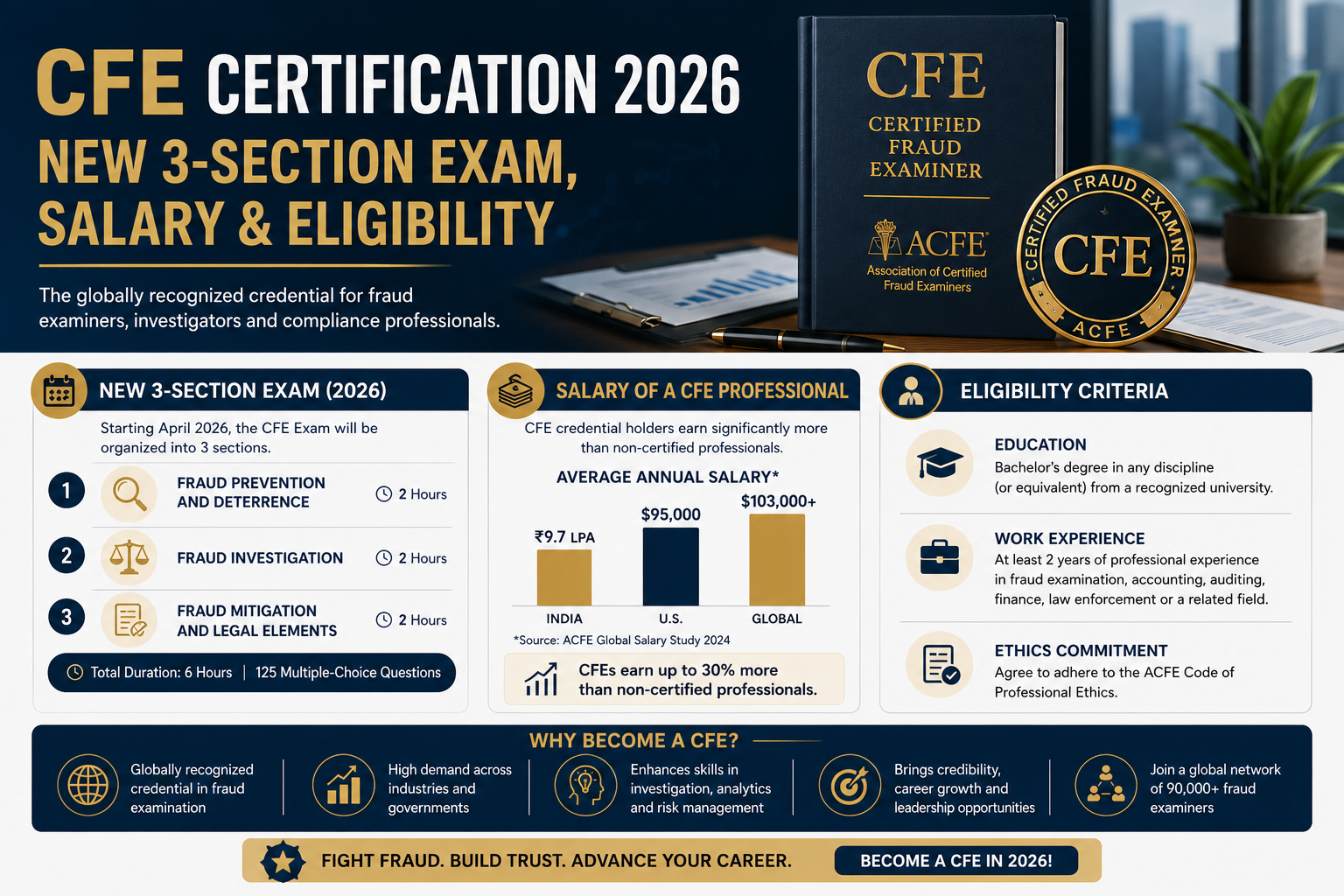
The CFE examination covers four distinct sections, each evaluated independently. Before diving into revision, you need to understand the weights and dynamics of each section.
- Financial Transactions & Fraud Schemes: Deep-dive into accounting concepts, asset misappropriation, bribery, corruption, and financial statement manipulation.
- Law: Legal systems, rules of evidence, testifying in court, and suspect/witness rights in civil and criminal proceedings.
- Investigation: Interview techniques, digital forensics, document analysis, tracing illicit assets, and report writing.
- Fraud Prevention & Deterrence: Why people commit fraud (the Fraud Triangle), corporate governance, compliance programs, and ethical frameworks.
During this setup phase, schedule your 35 hours into structured 75-minute daily slots. Consistency beats cramming; an hour every morning or evening keeps the cognitive load manageable while handling your full-time job.

Phase 2: Weeks 1 & 2 — Conquering Core Technicals
The first two weeks focus on the modules with the highest volume of technical terminology: Financial Transactions and Legal frameworks.
Week 1: Financial Transactions & Fraud Schemes
Dedicate 10 study hours across this week. Start with skimming the core theory of skimming, larceny, and billing schemes before jumping directly into practice questions.
- Focus heavily on inventory theft, payroll fraud, and check tampering mechanics.
- Review basic accounting equations, double-entry implications, and red flags for fictitious revenue.
- Run 50 practice questions per session, analyzing the exact rationales for incorrect options rather than simply memorizing correct answers.
Week 2: Law
Spend 8 study hours covering legal terminology. For Indian candidates, this module requires paying close attention to global standards and US common law roots that ACFE frequently tests.
- Master the differences between civil litigation and criminal prosecution standards of proof.
- Memorize the key requirements for chain of custody, search warrants, and wiretapping admissibility.
- Study the specific rights of employees during workplace investigations (Weingarten rights, Garrity warnings, and Fifth Amendment implications).
Phase 3: Weeks 3 & 4 — Mastering Investigative Methods & Final Mocks
The second half shifts toward procedural tactics, interview psychology, and end-to-end full-length simulation tests.
Week 3: Investigation & Fraud Prevention
Split 9 study hours evenly between the remaining two sections. These sections are largely intuitive for professionals with prior internal audit or compliance exposure.
- Investigation (5 Hours): Master the sequence of interviews (starting with neutral third parties and finishing with the primary target), non-verbal cues, and forensic data preservation.
- Fraud Prevention & Deterrence (4 Hours): Understand Cressey's Fraud Triangle (Pressure, Opportunity, Rationalization), COSO internal control frameworks, and organizational code of conduct rollouts.

Week 4: Intensive Practice & Mock Drilling
Your final 8 hours are reserved exclusively for simulation exams. Do not read raw text during this week; focus entirely on active recall.
- Take one timed 100-question mock test for each of the 4 sections.
- Maintain an error log noting whether missed questions stemmed from misreading the prompt, fact gaps, or second-guessing.
- Clear any remaining blind spots through one-on-one mentor review sessions to ensure your passing score baseline stays comfortably above the required 75%.
The inSAKE Advantage: Pay-After-Pass Mentorship
Studying on your own often leads to procrastination and getting stuck on niche international legal definitions. inSAKE Academy eliminates the financial and academic friction with India's first Pay-After-Pass CFE Program.
- Zero Upfront Fees: You do not pay our program fee until you have successfully passed your CFE exams.
- Daily 1-on-1 Mentorship: Get direct daily guidance from certified practitioners who tailor the 35-hour timeline to your work schedule.
- Precision Question Banks: Skip the 2,000-page manual and focus on high-yield exam patterns that reflect the current testing cycle.