When Indian banks write off thousands of crores in non-performing assets and corporate boardrooms face relentless regulatory scrutiny from the SFIO, ED, and SEBI, one question echoes across finance and audit floors: who is actually equipped to investigate financial crime? If you are an auditor, accountant, risk analyst, or compliance professional in India looking to carve out a high-demand niche, you have likely hit a crossroads trying to decide between the Certified Fraud Examiner (CFE), Certified Internal Auditor (CIA), and specialized Forensic Accounting diplomas.
While all three deal with organizational integrity, they solve fundamentally different problems. Choosing the wrong credential costs you months of study and tens of thousands of rupees without giving you the exact career leverage you wanted. Here is an honest, practical comparison of how the CFE stacks up against its closest alternatives, what the Indian job market genuinely rewards, and how to choose the right path for your specific goals.
The Core Differences: CFE vs CIA vs Forensic Accounting
To make an informed decision, you must first strip away marketing jargon and look at what each qualification trains you to do on day one.
Certified Fraud Examiner (CFE)
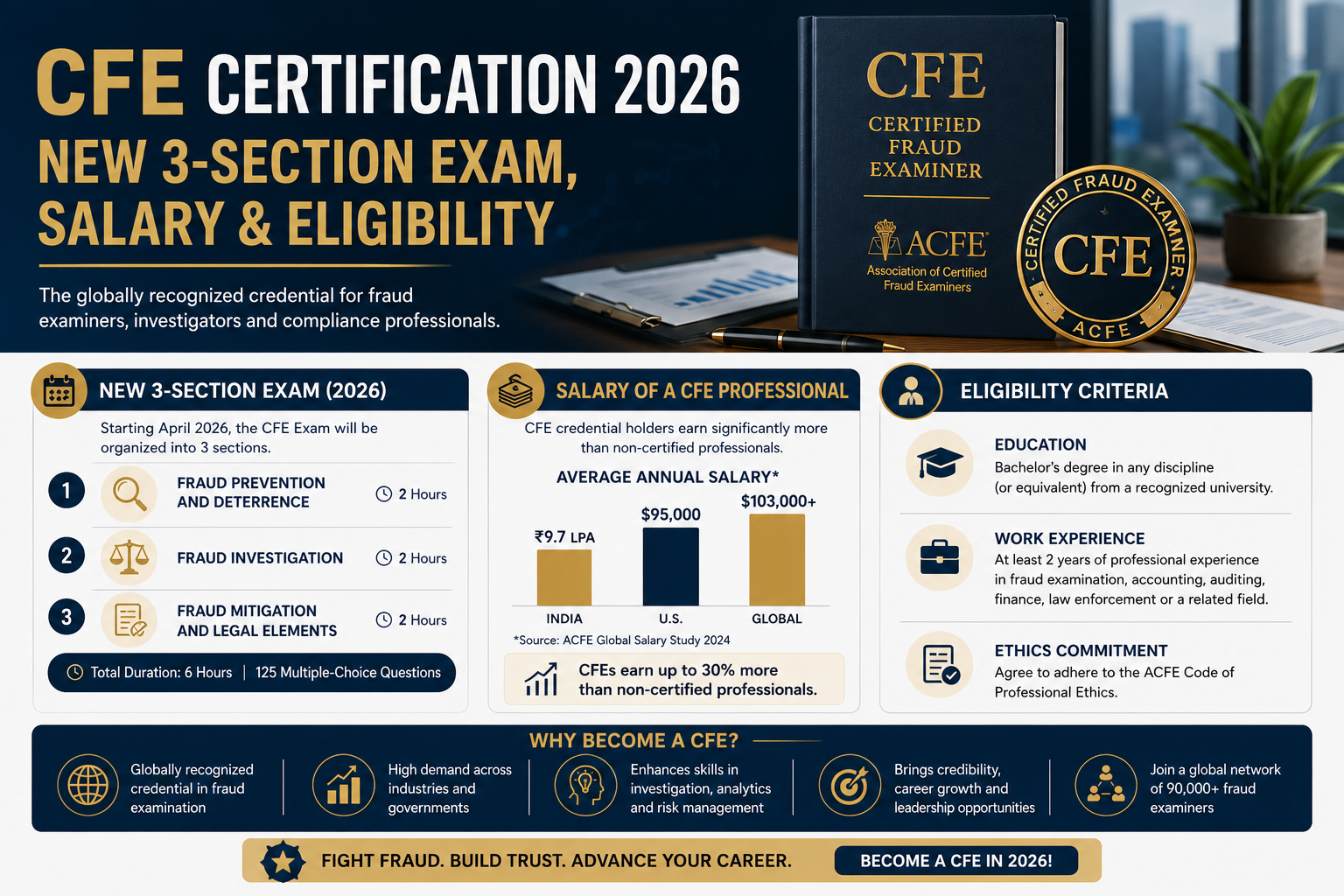
Awarded by the Association of Certified Fraud Examiners (ACFE), the CFE is the undisputed gold standard worldwide for anti-fraud professionals. It does not just teach you how to audit books; it trains you to build comprehensive fraud prevention architectures, detect red flags, gather legally admissible evidence, interview suspects, and navigate criminal and civil litigation. It covers four major pillars: Financial Transactions & Fraud Schemes, Law, Investigation, and Fraud Prevention & Deterrence.
Certified Internal Auditor (CIA)
Administered by the Institute of Internal Auditors (IIA), the CIA focuses broadly on enterprise governance, internal control frameworks (like COSO), risk management, and overall operational audit. While CIAs touch upon fraud risks, fraud is merely one component of a much wider operational audit mandate. A CIA ensures internal policies are followed; they rarely step in to lead an adversarial fraud interrogation.
Certificate / Diploma in Forensic Accounting (e.g., ICAI FAFD)
In India, forensic accounting programs (such as ICAI's Forensic Accounting and Fraud Detection certificate) are tailored heavily toward Chartered Accountants. They dive deep into ledger scrutiny, data analytics, and statutory compliance under Indian company law. However, they lack the global brand recognition, standardized cross-border investigative methodologies, and legal interview frameworks baked into the ACFE syllabus.

Curriculum, Effort, and Exam Structure Compared
Understanding the study investment and testing pattern is critical when balancing a demanding corporate job in Gurgaon, Mumbai, or Bengaluru.
- CFE Examination: 4 separate modules (Financial Transactions, Law, Investigation, Fraud Prevention). Each exam has 100 multiple-choice questions administered online via proctoring. The syllabus is practical and scenario-driven, requiring approximately 35 targeted study hours with structured mentorship.
- CIA Examination: 3 distinct parts covering internal audit fundamentals, practice, and business knowledge for internal auditing. CIA is notoriously theory-heavy and requires deep memorization of IIA standards, often taking 6 to 12 months of sustained preparation.
- Forensic Accounting (FAFD/Local Diplomas): Typically combines modular classroom training with practical lab work on tally/ERP extracts, followed by a local theoretical and practical exam. Highly India-centric, but less flexible for corporate global mobility.
Here is how the key parameters compare at a glance:
| Parameter | CFE (ACFE) | CIA (IIA) | Forensic Accounting Diplomas |
|---|---|---|---|
| Primary Focus | White-collar crime, fraud investigation, forensics | Governance, enterprise risk, operational controls | Balance sheet forensics, statutory dispute support |
| Global Recognition | Worldwide (180+ countries) | Worldwide | Primarily domestic (India-focused) |
| Ideal Study Time | ~35 focused study hours | 120-180 study hours | 60-100 study hours |
| Target Roles | Forensic Investigator, Risk Advisory, SFIO/Big 4 Forensics | Internal Auditor, Chief Audit Executive, SOX Consultant | Forensic Auditor, Expert Witness, Statutory Audit Support |
| Average India Salary | ₹12 Lakhs - ₹28 Lakhs/year | ₹9 Lakhs - ₹20 Lakhs/year | ₹8 Lakhs - ₹18 Lakhs/year |
Indian Market Demand: What Big 4 and Global Capability Centers Look For
Over the past five years, India has emerged as the central fraud risk and compliance hub for global multinationals. Global Capability Centers (GCCs) in Hyderabad, Bengaluru, and Pune manage compliance operations for Fortune 500 banks, while Big 4 forensic practices (Deloitte, PwC, EY, KPMG) in Mumbai and NCR command record billing rates for independent dispute investigations.
When hiring for Fraud Risk Management, Anti-Bribery & Corruption (ABAC), Whistleblower Investigations, or Anti-Money Laundering (AML), recruiters explicitly filter for the CFE credential. A candidate with a CFE signals immediate readiness to conduct forensic interviews, evaluate digital red flags, and assemble court-ready investigation reports.
While a CIA remains standard for routine internal audit rosters, a CFE commands a clear premium in specialized risk units. It is not uncommon for a mid-level professional transitioning from statutory audit to forensic advisory to secure a 30% to 50% compensation jump simply by credentialing with the CFE.

The 'Pick This If...' Verdict
Making the right choice comes down to your career target over the next 24 to 36 months:
Pick the CFE if:
- You want to work directly in forensic investigations, corporate intelligence, whistleblower management, or fraud risk analytics.
- You want a globally portable qualification that Big 4 advisory, tech giants, investment banks, and GCCs actively mandate for forensic roles.
- You want a high-ROI credential with a concise, targeted study investment (~35 hours) rather than multi-year academic grinding.
- You want to eliminate upfront financial risk through structured, pay-after-pass mentorship.
Pick the CIA if:
- Your primary career aspiration is climbing the ladder within corporate internal audit or becoming a Chief Audit Executive (CAE).
- You enjoy building enterprise-wide internal control frameworks, ERM, and SOX compliance systems across operational departments.
Pick Local Forensic Accounting if:
- You are a practicing Indian CA whose work is strictly confined to domestic litigation support, Indian tax fraud cases, or local court appointed inspections.
How inSAKE Academy Eliminates the Risk of CFE Preparation
Traditional professional exam prep in India forces you to pay heavy tuition fees upfront, attend generic weekend webinars with 100 other students, and hope you clear the exam on your own. inSAKE Academy completely flips that model.
With India's first Pay-After-Pass CFE Program, you take on zero upfront fee risk. You receive dedicated daily one-to-one mentorship, a razor-focused 35-hour study roadmap aligned directly with the ACFE testing methodology, and rigorous mock evaluations. You only pay your training fees once you have officially passed your exam and earned your CFE credential. This aligns our incentives directly with your success.