At 9:15 AM in a Gurugram corporate tower or a Bandra-Kurla Complex banking hub, a Certified Fraud Examiner (CFE) does not sit down to crunch standard ledger reconciliations. Instead, they open a triage dashboard flagged by automated risk analytics: three shell vendor entities in Pune sharing identical PAN prefixes, masked director directorates, and ₹4.2 crore in accelerated invoicing over the festive quarter.
If you are researching the CFE credential, you are likely wondering what the daily routine actually looks like once those letters are behind your name. Is it corporate auditing with a darker name, or an elite investigative role that commands board-level attention? Here is the unvarnished reality of what CFEs in India actually do every day, why their compensation consistently outpaces traditional accounting tracks, and how you can enter the field with zero upfront tuition risk.
09:00 – 11:30: Forensic Analytics and Anomaly Triaging
A CFE's morning revolves around data analytics rather than police tape. Modern corporate fraud rarely leaves a paper trail that can be spotted on a physical shelf; it hides in the noise of millions of enterprise resource planning (ERP) transactions.
During this window, a fraud examiner typically runs structured queries using specialized audit analytics tools like IDEA, ACL, or Python scripts tailored to forensic pattern recognition. They test datasets against Benford’s Law to detect manipulated figures, run fuzzy matching algorithms between employee bank details and vendor master files, and analyze procurement kickback flags.
- Identifying split purchase orders generated just below executive authorization limits.
- Correlating corporate credit card swipes with geo-location logs and vendor GST returns on the government portal.
- Flagging unauthorized access logs in core banking software during off-market hours.

11:30 – 14:00: The Admission-Seeking Interview
Data proves an irregularity exists, but human testimony explains intent. Under ACFE standards, the fraud examination methodology separates an exploratory inquiry from an admission-seeking interview. This is where a CFE's psychological training steps into the spotlight.
Mid-day hours are frequently dedicated to witness interviews and suspect engagements. An examiner does not enter a room accusing someone of siphoning corporate funds. They follow a deliberate, methodical approach rooted in the Fraud Triangle: establishing pressure, opportunity, and rationalization.
In an Indian corporate context, this might involve interviewing a regional procurement lead regarding why a high-bid vendor without a registered warehouse repeatedly won tenders. The CFE structures questions neutrally, reading verbal inflection and micro-contradictions, steadily introducing documentary evidence until the narrative shifts from administrative oversight to documented confession.
14:30 – 16:30: Evidence Preservation and Legal Coordination
Uncovered evidence is useless if it is inadmissible. Fraud examiners must bridge the divide between corporate accounting, IT infrastructure, and Indian evidence law (including Section 65B certifications under the Indian Evidence Act for electronic records).
During the afternoon, a CFE works closely with in-house legal counsel, external forensics partners, and sometimes statutory regulators. If digital devices are involved, they oversee chain-of-custody protocols for cloned laptop drives, encrypted messaging backups, and secure server dumps.
- Verifying metadata integrity for critical spreadsheets and approval emails.
- Drafting preliminary factual summaries for the Audit Committee or Whistleblower Review Board.
- Liaising with external counsel to determine whether the findings meet the threshold for filing a First Information Report (FIR) or initiating civil asset recovery.

16:30 – 18:30: Executive Reporting and Preventative Architecture
A CFE does not just dig up past wreckage; they re-engineer internal controls so the breach cannot happen twice. The final part of the day involves translating complex accounting anomalies into direct, actionable business risk reports for the board of directors.
CFEs present root-cause analyses that highlight governance gaps. If an employee bypassed segregation of duties due to inherited ERP super-user permissions, the CFE outlines the systemic fix: dynamic multi-factor approvals, periodic entitlement recertification, and continuous behavioral risk monitoring.
The Indian Market Reality: Roles and Compensation
Corporate India is dealing with unprecedented regulatory scrutiny from bodies like the Serious Fraud Investigation Office (SFIO), the Reserve Bank of India (RBI), and the Enforcement Directorate (ED). At the same time, venture-funded unicorns and established conglomerates are under immense investor pressure to stamp out balance sheet inflation and procurement kickbacks.
As a result, demand for certified professionals spans multiple sectors across India:
- Big 4 Forensic Practices (EY, Deloitte, PwC, KPMG): Roles span Forensic Senior Consultant to Director, managing multi-jurisdiction bribery and FCPA investigations.
- Banking & Financial Services (HDFC, ICICI, Axis, Global In-House Centers): Fraud risk managers overseeing AML alerts, trade finance manipulation, and credit loan syndication fraud.
- Tech Unicorns and Listed Corporates: In-house Internal Audit, Whistleblower Oversight, and Ethics teams.
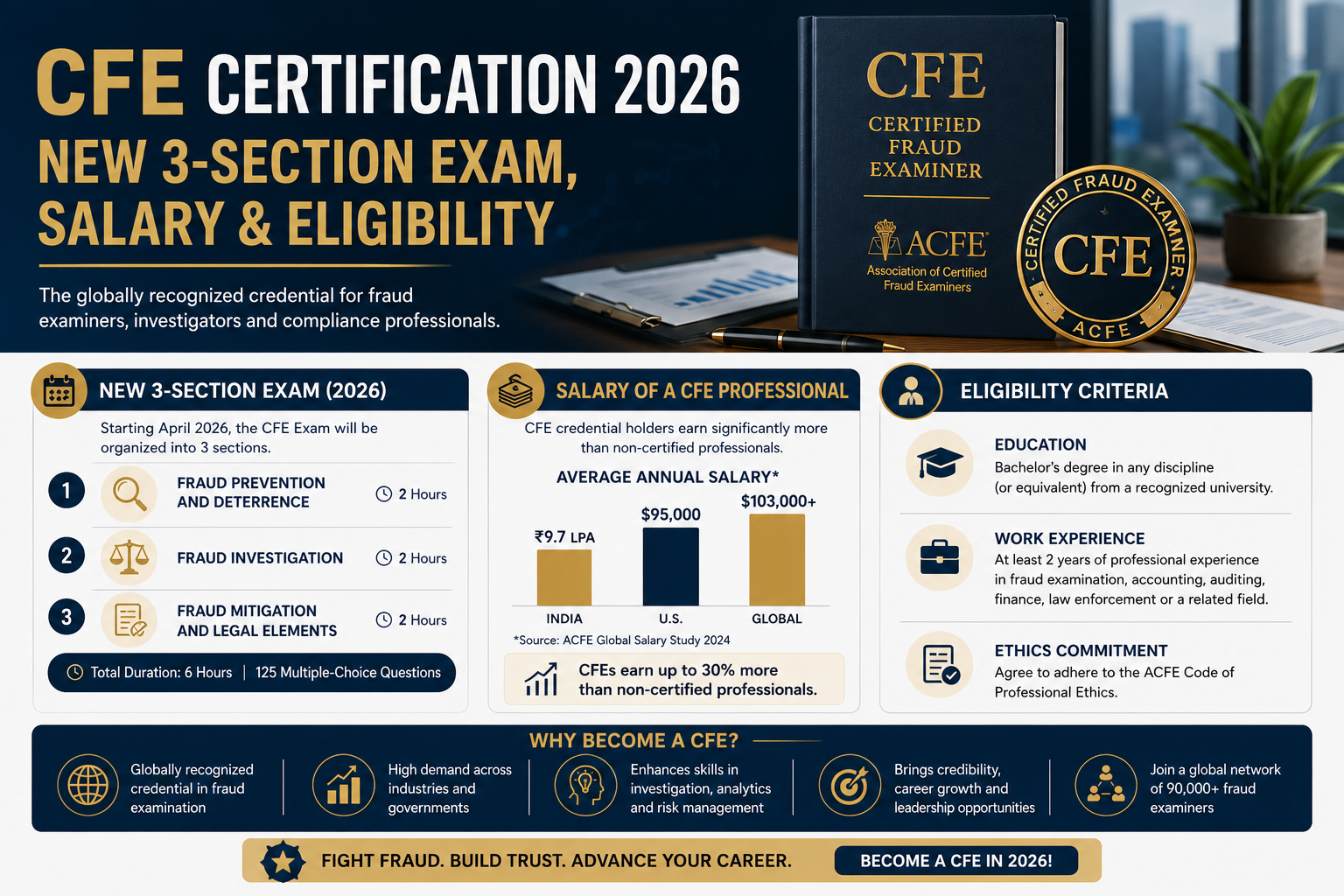
In India, a professional with a CFE credential typically commands ₹12 LPA to ₹18 LPA in mid-tier roles, while seasoned managers and associate directors with 7–10 years of cross-functional experience routinely clear ₹25 LPA to ₹35+ LPA.
The 35-Hour Fast Track: How inSAKE Academy Changes the Game
Traditional professional certifications demand months of isolated textbook memorization and exorbitant upfront coaching fees. inSAKE Academy rewrites this equation with an intensive, structured 35-study-hour curriculum designed around the busy schedules of working professionals.
Most importantly, inSAKE Academy offers India's First Pay-After-Pass CFE Program. You commit zero upfront coaching fees. You receive daily one-to-one mentorship from practicing forensic leaders, curated exam question banks, and dedicated concept drills covering all four ACFE modules (Financial Transactions & Fraud Schemes, Law, Investigation, and Fraud Prevention & Deterrence). You only pay when you clear the exam and secure your global CFE credential.