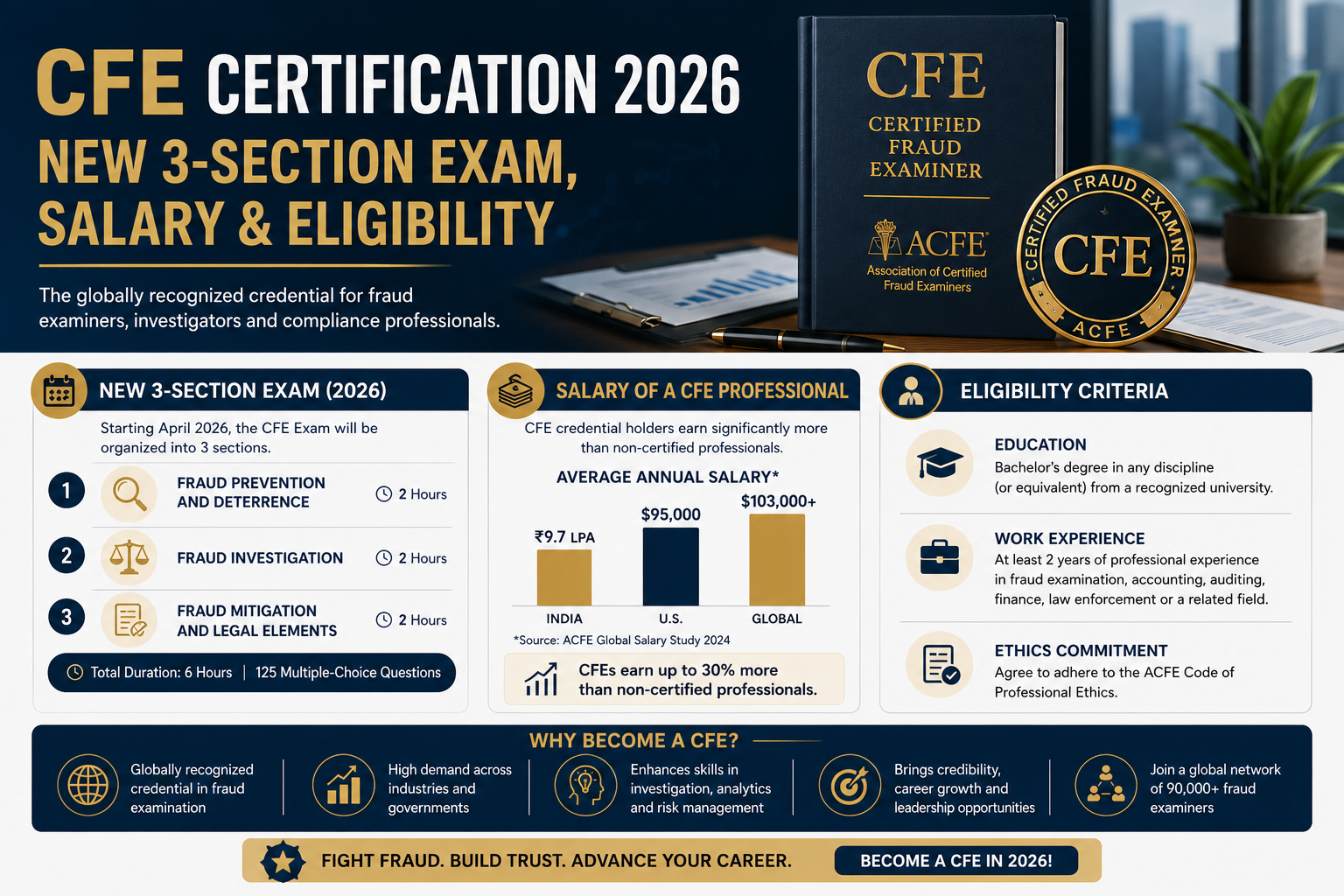
The Certified Fraud Examiner (CFE)® is the world's leading anti-fraud credential — and in 2026 the exam itself has changed. As of 2 June 2026, the ACFE moved the CFE Exam to a new three-section structure. With global fraud losses in the trillions and digital financial crime rising fast, demand for skilled fraud examiners has never been higher.
What is the CFE certification?
CFE is awarded by the ACFE and recognized internationally. It validates your expertise in detecting, investigating, and preventing fraud across financial transactions, schemes, investigations, and prevention. CFEs work in internal audit, compliance, banking, forensic accounting, corporate investigations, and law enforcement.
Why pursue CFE in 2026?
- It commands a clear premium. The ACFE reports CFEs earn roughly 32% more than non-certified colleagues.
- Demand is surging. Rising digital-payment abuse, mule-account schemes, loan and insurance fraud, and internal collusion are driving organizations to hire anti-fraud specialists.
- Globally respected. Recognized across BFSI, the Big Four, and corporate investigation teams worldwide.
- Skills transfer widely. CFE competencies apply to internal audit, risk, and compliance roles.
The new 2026 CFE exam (3 sections)
From 2 June 2026, the CFE Exam has three sections:
- Fraud Schemes & Financial Crimes — financial transaction red flags, asset misappropriation, corruption, financial statement fraud, and digital/cyber-enabled fraud.
- Fraud Investigations & Legal Issues — planning and conducting investigations, interviewing, evidence handling, report writing, and the legal framework.
- Fraud Prevention & Deterrence — fraud risk assessment, internal controls, ethics, governance, and anti-fraud programs.
The updated exam uses multiple-choice and true/false questions and is delivered online via Prometric.
CFE eligibility
- ACFE Associate Membership (required before the exam).
- A minimum of 40 eligibility points, awarded based on education and professional experience.
- Relevant fraud-related professional experience by the time of certification.
- Agreement with the ACFE Code of Ethics.
CFE salary in India (2026)
- Entry-level (fraud analyst): ₹4–10 LPA
- Mid-level (forensic auditor / investigator): ₹10–18 LPA
- Senior (financial-crime / compliance lead): ₹20–25 LPA+
Career paths after CFE
Fraud analyst, forensic auditor, investigator, AML/financial-crime specialist, internal auditor, and compliance leader. Demand and pay are strongest in BFSI, the Big Four, and corporate investigation teams.
How to pass the CFE on your first attempt: a study plan
- Master all three sections — give particular attention to Fraud Schemes & Financial Crimes.
- Learn the investigative and legal framework — understand how evidence, interviews, and legal constraints fit together.
- Internalize prevention and deterrence — fraud risk assessment, controls, and ethics are heavily tested.
- Practice with mocks built on the new 3-section format.
- Sort ACFE membership and eligibility points early.
Get CFE certified — and pay only after you pass
At inSAKE Academy, you get daily one-to-one mentorship, a 100% pass guarantee, and all materials free — and you pay only after you are certified. We train you on the new 2026 three-section exam and guide you through ACFE membership, eligibility points, and the full application.
Frequently asked questions
The exam changed in June 2026 — does that affect me? Yes — it is now a three-section format, so training on the current structure is essential.
Is the CFE worth it in India? Yes — CFEs earn around 32% more than non-certified peers, with strong demand in BFSI and corporate investigations.
Can I start preparing before I meet the experience requirement? Yes — you can begin preparation while working toward full eligibility.
How many sections does the CFE exam have now? Three, since 2 June 2026 — Fraud Schemes & Financial Crimes, Fraud Investigations & Legal Issues, and Fraud Prevention & Deterrence.
Can a fresher become a CFE? You can begin preparation, but certification requires meeting the points-based eligibility (40 points) and relevant fraud-related experience.
CFE vs CA — which is better? Different goals: CA is a broad accounting qualification; CFE specializes in fraud detection and investigation. The CFE complements a CA very well.