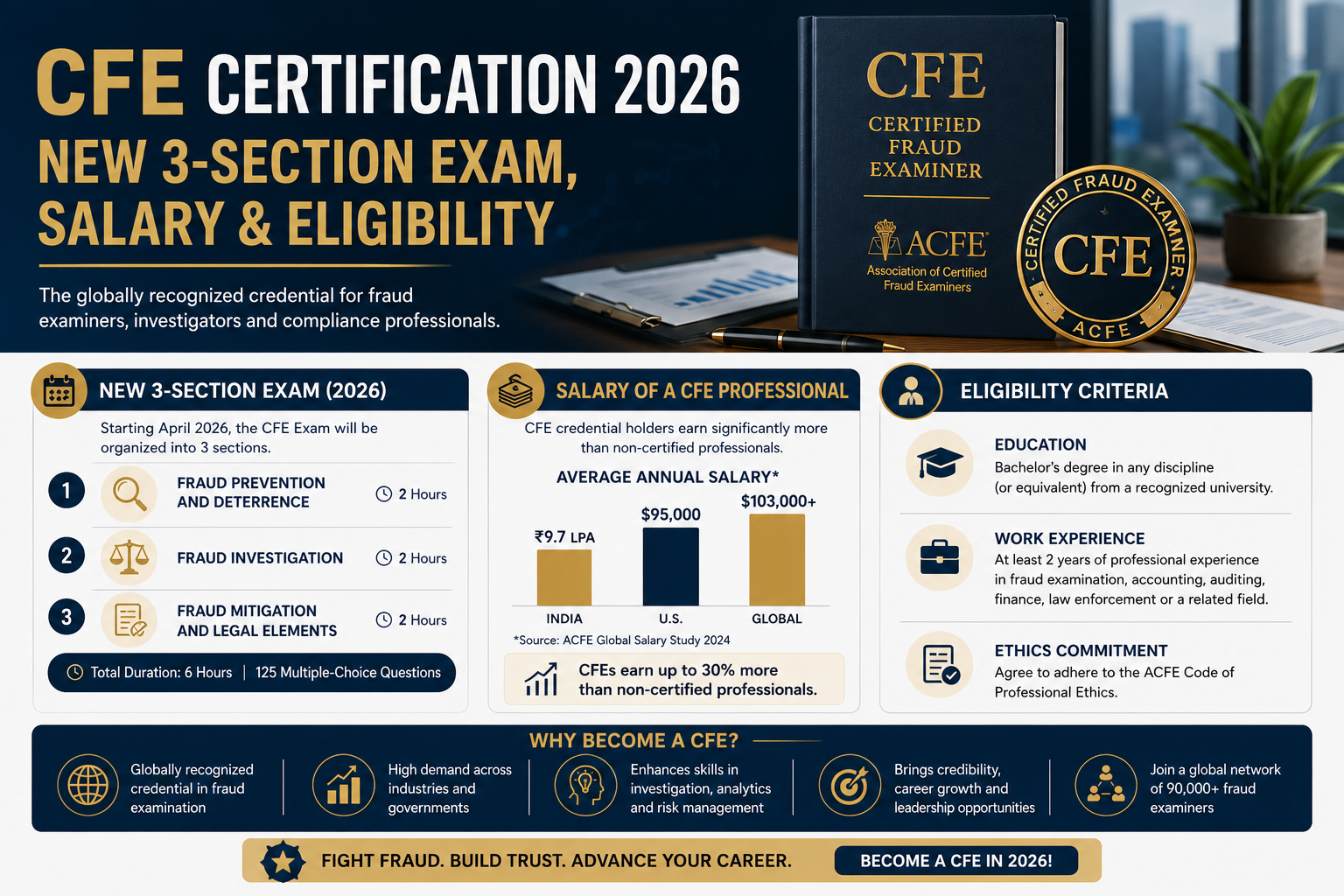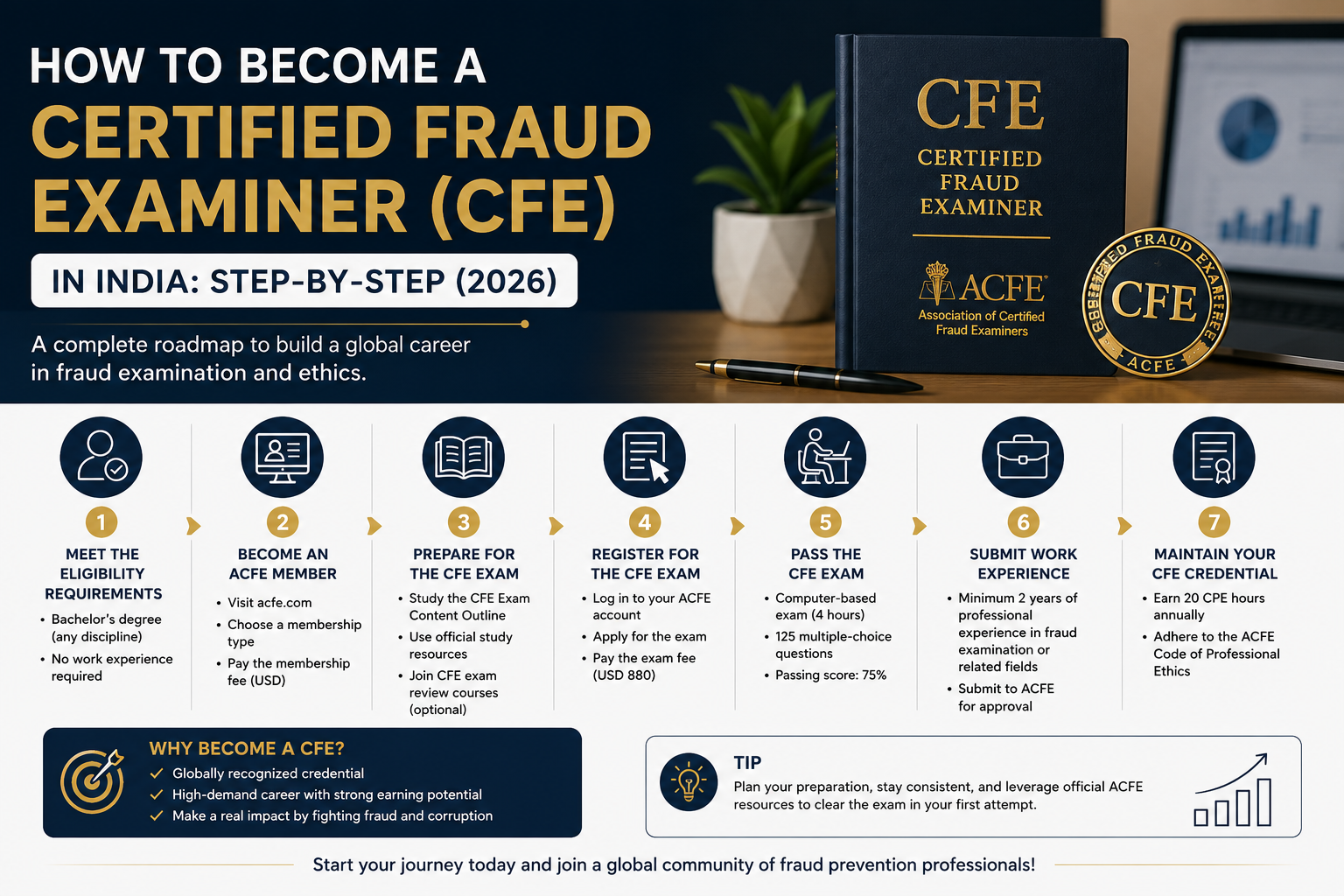
Fraud is rising — across digital payments, lending, insurance, and inside organizations themselves — and the people trained to fight it are in serious demand. The Certified Fraud Examiner (CFE)® is the world's leading anti-fraud credential, and in 2026 the exam moved to a new three-section format. Here is exactly how to become a CFE in India, step by step.
What is a Certified Fraud Examiner?
A CFE is a specialist trained to detect, investigate, and prevent fraud. Awarded by the ACFE, the credential is recognized internationally across BFSI, the Big Four, corporate investigation teams, and law enforcement. CFEs identify red flags in transactions, run structured investigations, build evidence and reports, and design controls that deter fraud.
Why become a CFE in 2026?
- The ACFE reports CFEs earn roughly 32% more than non-certified peers.
- Demand is surging as digital-payment abuse, mule accounts, loan and insurance fraud, and internal collusion rise.
- Skills transfer directly into internal audit, risk, and compliance.
- Globally respected, opens specialist roles that pay a premium.
Step 1 — Join the ACFE as an Associate Member
ACFE Associate Membership is required before you can sit the exam. For Indian candidates, membership generally costs around US$60–70 per year (confirm current rates on acfe.com).
Step 2 — Meet the eligibility points requirement
The CFE uses a points-based eligibility system. You need a minimum of 40 points, awarded based on education and professional experience, plus relevant fraud-related experience by the time of certification. You can begin preparing before fully meeting the experience requirement.
Step 3 — Prepare for the new 3-section exam
Since 2 June 2026, the CFE Exam has three sections:
- Fraud Schemes & Financial Crimes
- Fraud Investigations & Legal Issues
- Fraud Prevention & Deterrence
Multiple-choice and true/false questions delivered online via Prometric. Study all three sections, with particular focus on fraud schemes and the legal content within investigations.
Step 4 — Take and pass the exam
Once your eligibility is activated, schedule and complete the exam within your defined window (always confirm current timing on acfe.com). Use mock exams built on the new three-section format to build readiness.
Step 5 — Earn and maintain your CFE
After passing and meeting all requirements, you receive the CFE credential. Maintain it by keeping your ACFE membership active and completing the required CPE each year.
Careers and salary after CFE
- Entry-level (fraud analyst): ₹4–10 LPA
- Mid-level (forensic auditor / investigator): ₹10–18 LPA
- Senior (financial-crime / compliance lead): ₹20–25 LPA+
The types of fraud a CFE investigates
Asset misappropriation, corruption and bribery, financial statement fraud, payroll and expense fraud, vendor and procurement fraud, insurance and loan fraud, and the fast-growing categories of digital-payment and cyber-enabled fraud.
Industries hiring CFEs in India
Demand is strongest in BFSI (banks, NBFCs, and insurers), the Big Four, large corporates' internal audit teams, fintech and digital-payment companies, and consulting.
Get CFE certified — pay only after you pass
inSAKE Academy trains you on the new 2026 three-section exam with daily one-to-one mentorship, a 100% pass guarantee, and all materials free — and you pay only after you are certified. Book a free mentor session today.
Frequently asked questions
How long does it take to become a CFE? Typically a few weeks to a couple of months of structured study, plus time to meet membership and eligibility requirements.
Do I need a specific degree? No — eligibility is points-based, combining education and experience.
Is fraud examination a growing field? Yes — rising digital and financial crime is driving strong demand for anti-fraud specialists.
Can a CA or CMA add the CFE? Yes — it complements accounting qualifications very well for forensic and investigation roles.
Is the CFE recognized by Indian employers? Yes — widely respected across finance, audit, investigation, and law enforcement.